




Handcrafted vs Machine-Made Silver Jewellery: What's the Difference?

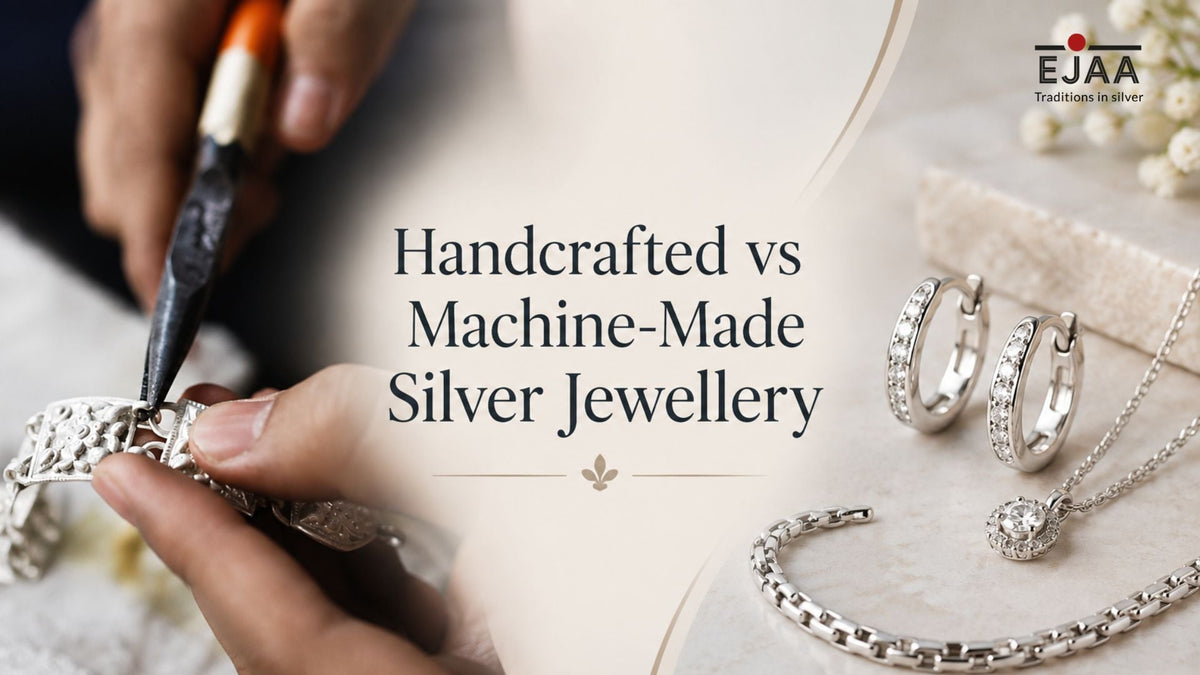
Handcrafted silver jewellery is shaped, engraved, and finished by hand. In contrast, machine-made jewellery is produced through automated casting and stamping for speed and consistency; the difference shows up in cost, uniqueness, and how the piece feels once you're actually wearing it. Handcrafted pieces carry small variations from human hands rather than a mould, which is exactly what gives artisan jewellery its character. Machine-made jewellery, on the other hand, prioritises uniformity and affordability, producing near-identical pieces at scale.
Neither is inherently better; it depends on whether you're buying for individuality or for budget-friendly, everyday consistency. Here's how the two actually compare.
Handcrafted vs Machine-Made: Quick Comparison
|
Factor |
Handcrafted Silver Jewellery |
Machine-Made Silver Jewellery |
|
Production |
Shaped and finished by artisans |
Cast or stamped using automated tools |
|
Uniqueness |
Slight variations, no two pieces identical |
Uniform, identical across pieces |
|
Detailing |
Intricate, hand-finished engraving |
Precise but often shallower detailing |
|
Price |
Generally higher, reflects labour and skill |
Generally more affordable |
|
Production Time |
Slower, often one piece at a time |
Fast, suited to large quantities |
|
Emotional Value |
Feels personal, often tied to tradition |
Feels functional, more replaceable |

How to Tell If a Piece Is Genuinely Handcrafted
Not every "handmade" label online is accurate. A few checks can help.
-
Look closely for slight asymmetry or tool marks; genuine hand-finishing rarely looks machine-perfect
-
Compare weight and thickness between two "identical" pieces; handcrafted items often vary slightly
-
Ask about the maker or artisan community behind the piece; genuine sellers can usually explain their process. Ejaa's own artisan story is a good example of what that transparency looks like
-
Be cautious of unique jewellery names or "artisan" labels used purely as marketing on mass-produced stock
Which One Should You Choose?
-
For gifting or sentimental pieces: handcrafted jewellery tends to carry more meaning and cultural weight
-
For everyday, budget-friendly wear: machine-made pieces offer consistency and lower cost
-
For collectors or those who value individuality: handcrafted, intricate jewellery is usually the better long-term choice, and it helps to understand how a piece is actually made before comparing prices
-
For ethical or eco-friendly jewellery preferences: handcrafted pieces often align better with sustainable, small-batch production
-
If purity matters alongside craftsmanship: it's worth reading up on 925 vs 999 silver, since the two considerations are related but not the same

Final Thoughts
At Ejaa, every piece is handcrafted by artisans in Uttarakhand using traditional Pahadi and Kumaoni techniques, prioritising individuality over mass production. You can explore the full handcrafted silver jewellery collection to see this approach in practice.
FAQs
What are the key differences between handmade and machine-made jewellery?
Handmade jewellery is shaped by artisans with slight natural variation, while machine-made jewellery is produced through automated processes for speed and uniformity.
Which type of silver is best for jewellery?
925 sterling silver is the standard for durable, wearable jewellery, while 999 fine silver is softer and better suited to coins or investment pieces.
What is considered handcrafted jewellery?
Jewellery shaped, engraved, or finished primarily by hand using traditional tools and techniques, rather than automated casting or stamping.
Is handmade jewellery more expensive?
Generally yes, since it reflects the time, skill, and labour involved, compared to the faster, large-scale production behind machine-made pieces.
What handmade jewellery is trending now?
Heritage-inspired, artisan-made silver pieces are seeing renewed interest, especially among younger buyers moving away from mass-produced fashion jewellery.
How can I tell if jewellery is genuinely handmade?
Look for slight asymmetry, tool marks, or weight variation between similar pieces, and ask sellers directly about their production process.