







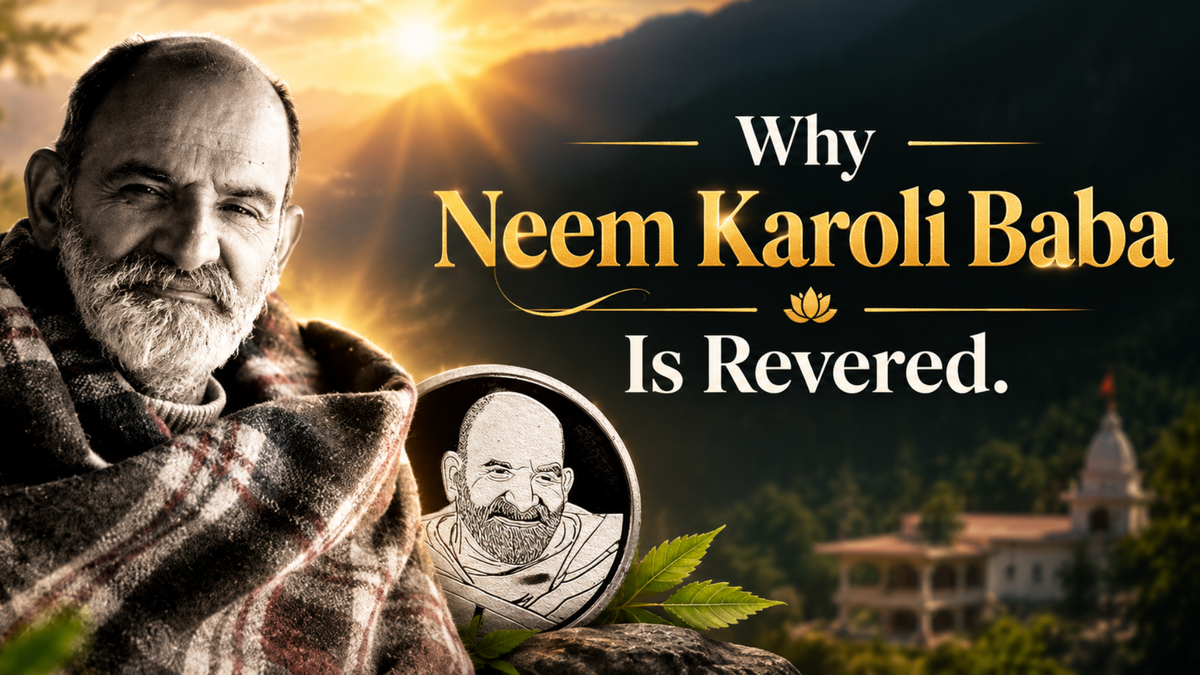
Why Neem Karoli Baba Is Revered: His Life, Teachings and Legacy

Neem Karoli Baba (c. 1900-1973) is revered as a Hanuman devotee and saint whose simple message, to love everyone, serve everyone, and remember God, drew seekers from Kumaon villages to Silicon Valley. Devotees call him Maharaj-ji. They revere him less for any teaching he wrote down, since he wrote none, than for the way he lived it: with humility, humour and open-handed generosity.
Who Was Neem Karoli Baba?
Born Lakshmi Narayan Sharma around 1900 in Akbarpur village, in present-day Firozabad district of Uttar Pradesh, he came from a wealthy Brahmin family, according to Neem Karoli Baba's biography. His parents married him off at the age of 11, and soon after, he left home to wander North India as a sadhu known as Baba Lakshman Das.
At his father's request, he later returned to live a settled family life and had two sons and a daughter. His spiritual path, however, never changed. It was rooted in bhakti, especially devotion to Lord Hanuman.
How He Got the Name Neeb Karori
The most popular story about Baba Neeb Karori involves a train. Travelling without a ticket, he was put off at Neeb Karori village in Farrukhabad district. The train reportedly would not move again until officials asked him to reboard. He stayed in the village for some time, and locals began calling him by its name. Western followers later found "Karori" hard to pronounce, which helped "Neem Karoli" become the more common spelling.
Kainchi Dham and the Kumaon Connection
In 1964, a Hanuman temple and ashram were built at Kainchi, on the Nainital to Almora road. Maharaj-ji spent much of his final decade here, meeting visitors with a few words, a laugh or a piece of fruit.
Every year on 15 June, the Kainchi Dham Mela marks the ashram's foundation day and draws large crowds of pilgrims. His other main ashram is in Vrindavan, and people eventually built over 100 temples in his name.
What Did Neem Karoli Baba Teach?
He did not write books or give formal sermons. His teaching was lived through everyday actions:
- Love everyone: see the divine in every person, whatever their background. Visitors of every faith and class were received the same way.
- Serve everyone: seva, especially feeding the hungry, was central to ashram life. No one left Kainchi without prasad.
- Remember God: constant remembrance of Ram's name and devotion to Hanuman, over complex ritual.
- Live simply: humility and surrender over status and possessions.
This simplicity is why karoli baba's message reached farmers, students, and foreign seekers alike. There was nothing complicated to interpret.
Why Seekers From Across the World Came
Harvard psychologist Richard Alpert met him in 1967 and became Ram Dass. His book "Be Here Now" introduced Maharaj-ji to millions in the West. Larry Brilliant, another devotee, went on to work on smallpox eradication and co-founded the Seva Foundation.
Some well-known stories need context:
- Today, his legacy lives on in the ashrams at Kainchi Dham and Vrindavan, in the temples built in his name, and in the service work of devotee-led organisations.
- Steve Jobs travelled to India in 1974 hoping to meet him, but Maharaj-ji had passed away the previous September.
- Mark Zuckerberg visited Kainchi Dham in Facebook's early days on Jobs's advice, and spoke about the trip publicly in 2015.
- Larry Page of Google and Jeffrey Skoll of eBay have also visited the ashram.
- Julia Roberts has said a picture of Maharaj-ji drew her towards Hinduism.
His Final Days and Lasting Legacy
Baba Neem Karoli died on 11 September 1973 in a Vrindavan hospital after falling into a diabetic coma. He had been travelling back to Kainchi from Agra. His last words, repeated several times, were "Jaya Jagadish Hare." His samadhi stands in the Vrindavan ashram.
His influence continues through the Seva Foundation, the Love Serve Remember Foundation, and two 2026 films: Shree Baba Neeb Karori Maharaj and Hanuman Ansh.
How Can We Connect With Neem Karoli Baba Today?
Maharaj-ji left no formal rituals behind. Devotees believe the way to feel close to him is to live by what he taught. Simple daily practices help:
- Remember Ram's name: Chant Ram's name or recite the Hanuman Chalisa, a practice many of his devotees follow every day.
- Practise seva: Feed someone in need or help others without expecting anything in return, just as he did at Kainchi.
- Visit his ashrams: Spend time at Kainchi Dham or the Vrindavan ashram. Many devotees plan their visit around the 15 June foundation day.
- Keep a daily reminder: Place his image or a sacred keepsake in your puja space so his message stays part of everyday life.
Many families keep a Neem Karoli Baba silver coin in their puja room as a symbol of his blessings. Others gift one for a griha pravesh, a wedding, or a new beginning.
Keeping Maharaj-ji Close
For many devotees, especially families across Kumaon, faith is something carried every day. Ejaa, a silver jewellery studio in Haldwani that has supported Uttarakhand artisans since 1985, handcrafts the Neem Karoli Baba Silver Coin in 999 fine silver. Local craftspeople make each coin with care, so devotees can keep Maharaj-ji's message of love, service, and remembrance close at home.
FAQs
What was Neem Karoli Baba’s real name?
His birth name was Lakshmi Narayan Sharma, also recorded as Lakshman Narayan Sharma.
How can I connect with Neem Karoli Baba today?
Devotees connect with Maharaj-ji by chanting Ram’s name, reciting the Hanuman Chalisa, doing seva, visiting Kainchi Dham, or baba ji silver coin in their puja space.
Why did Mark Zuckerberg go to Kainchi Dham?
Steve Jobs suggested the visit during a difficult early phase at Facebook, and Zuckerberg later described it as a time of reflection on his company’s mission.
What were Neem Karoli Baba’s last words?
He repeated “Jaya Jagadish Hare,” meaning “Hail to the Lord of the Universe.”
Who was Neem Karoli Baba devoted to?
He was a lifelong devotee of Lord Hanuman, and many devotees regard him as a form of Hanuman himself.
What were Neem Karoli Baba’s main teachings?
His core message was to love everyone, serve everyone, remember God and feed the hungry. He taught through simple actions and short conversations, not formal sermons.
Where was Neem Karoli Baba born?
He was born around 1900 in Akbarpur village, in present-day Firozabad district of Uttar Pradesh.
Are Neem Karoli Baba and Neeb Karori Baba the same person?
Yes. Neeb Karori is the original name taken from a village in Farrukhabad district, and Neem Karoli became the more common spelling over time.
When did Neem Karoli Baba pass away, and where is his samadhi?
He passed away on 11 September 1973 in Vrindavan. His samadhi stands within the Vrindavan ashram.



%20is%20revered%20as%20a%20Hanuman%20devotee%20and%20saint%20whose%20simple%20message,%20to%20love%20everyone,%20serve%20everyone,%20and%20remember%20God,%20drew%20seekers%20from%20Kumaon%20villages%20to%20Silicon%20Vall...)