




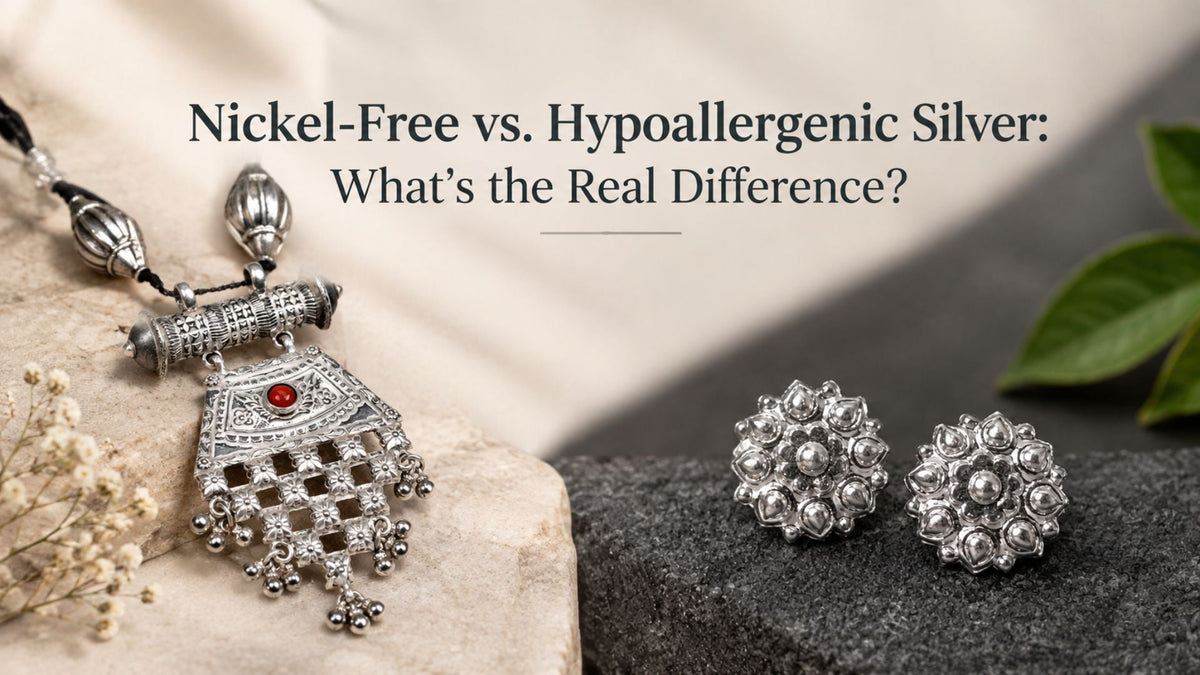
Nickel-Free vs. Hypoallergenic Silver: What's the Real Difference?

Nickel-free and hypoallergenic are not the same thing, even though jewellery listings often use them interchangeably. Nickel-free means a piece contains no detectable nickel, the single most common metal allergen in jewellery. Hypoallergenic is a broader, unregulated marketing term that simply means a product is less likely to cause a reaction, but it can still contain small amounts of nickel or other allergens.
If you already know you react to nickel, nickel-free is the safer, more specific claim to look for. If your skin is generally sensitive but you're not sure why, hypoallergenic pieces from a transparent brand are a reasonable starting point; just don't assume the word guarantees anything on its own.
What "Nickel-Free" Actually Means
Nickel-free means the metal itself, not just the surface plating, has no detectable nickel. This matters because nickel is the leading cause of earring allergy and contact dermatitis worldwide, especially after piercing.
-
Common nickel-free metals: 925 sterling silver, high-karat gold, titanium, platinum
-
Well-made pieces are usually cadmium-free too, another heavy metal worth checking for in cheap costume jewellery
-
Watch out: white gold and even "surgical" stainless steel often still contain nickel, despite popular belief
What "Hypoallergenic" Actually Means
Hypoallergenic sounds reassuring, but the U.S. FDA has said plainly that there's no legal definition for the term a brand can use it however it wants. In practice, hypoallergenic products aim to reduce reactions from several allergens, not just nickel, but that doesn't guarantee they're nickel-free.
Nickel-Free vs. Hypoallergenic: Side-by-Side
|
Aspect |
Nickel-Free |
Hypoallergenic |
|
Meaning |
No detectable nickel |
Less likely to cause a reaction |
|
Regulation |
A specific, checkable claim |
Not a legally defined term |
|
Allergen scope |
Targets nickel specifically |
May loosely cover several allergens |
|
Best for |
A confirmed nickel allergy |
General sensitivity, cause unclear |
|
Common materials |
925 silver, titanium, platinum, high-karat gold |
Varies by brand |
Why This Matters More With Indian Jewellery
A lot of "allergic to fake earrings" complaints in India actually trace back to German silver or brass-alloy jewellery, a nickel-heavy mix that isn't real silver at all, despite the name. Genuine 925 sterling silver is alloyed with copper, not nickel, which is why real silver earrings rarely cause the same reaction as low-cost imitation pieces sold as "silver."
Final Thoughts
If nickel is the confirmed problem, look specifically for nickel-free labelling not just hypoallergenic. At Ejaa, every piece is crafted in certified 925 sterling silver, which is naturally nickel-free by composition rather than by marketing claim.
Frequently Asked Questions
What does nickel-free actually mean on a jewellery label?
It means the metal itself, not just the plating, has no detectable nickel, lowering the risk of a nickel allergy reaction.
Is hypoallergenic jewellery guaranteed to be nickel-free?
No. Hypoallergenic isn't a regulated term, so a piece can be labelled hypoallergenic and still contain trace nickel.
What's the best metal for sensitive or newly pierced ears?
925 sterling silver, titanium, and platinum are generally the safest choices, since none of them rely on nickel for strength.
Does white gold contain nickel?
Often, yes. White gold is often alloyed with nickel for its bright colour, which is why some people react to it even though pure gold is hypoallergenic.
Why do I react to imitation jewellery but not real silver?
Imitation pieces are often German silver or brass-nickel alloys, not real silver, so genuine 925 silver rarely triggers the same reaction.
Is surgical stainless steel nickel-free?
Not always. Despite the name, many stainless steel alloys used in jewellery still contain small amounts of nickel.
How can I check if a piece is genuinely nickel-free?
Look for a hallmark like 925 for silver, ask the seller what alloy is used, or use a home nickel-testing kit if you're highly sensitive.