





BIS Hallmark on Silver Jewellery: What It Means & How to Check Before Buying in India
 A BIS hallmark on silver jewellery is a government-recognised purity certification made up of three marks: the BIS Standard Mark with the word SILVER, a purity grade such as 925, and a six-digit HUID code that anyone can verify for free on the BIS Care app. As of September 2026, silver hallmarking in India is voluntary, but every hallmarked silver article must carry a HUID.
Silver has always been more than a metal in India, from the nath worn at a puja to the pahuchi passed down through generations. Yet for decades, buyers had no reliable way to know if a piece marked "925" was truly 92.5% pure silver.
BIS hallmarking for silver jewellery changes that. Since September 2025, every hallmarked piece carries a traceable HUID code, so you can verify its purity in seconds before you buy.
What Is BIS Hallmarking for Silver Jewellery?
BIS stands for the Bureau of Indian Standards, India's national body responsible for quality certification across industries.
BIS hallmarking is the official process of certifying the purity of precious metals. You've likely seen the BIS hallmark on gold jewellery for years. Silver hallmarking has been available voluntarily since 2005, and from 1 September 2025 it moved to a HUID-based digital system under the revised IS 2112:2025 standard.
Simply put: a BIS hallmark on your silver piece is the government's stamp of guarantee that what you're buying is exactly what it claims to be.
Why Did India Need Silver Hallmarking?
The silver jewellery market in India is enormous and historically unregulated.
Unlike gold, silver jewellery had no mandatory purity verification system for a long time. Sellers could label a piece "pure silver" with little to no accountability. The problem this created:
• Adulterated silver sold at pure silver prices
• No traceability: buyers couldn't identify the seller or testing centre
• Lack of standardisation hurt India's position in global silver trade
• Artisans and honest jewellers lost business to cheaper, impure alternatives
BIS hallmarking addresses all of this head-on.
The New System: What Changed in 2025
From September 1, 2025, BIS introduced a new hallmarking system for silver under standard IS 2112:2025. Here's what's new:
The HUID Code Is Now Central
Every hallmarked silver piece now carries a 6-digit alphanumeric HUID Hallmark Unique Identification number. Think of it as your jewellery's fingerprint. No two pieces share the same HUID.
Seven Purity Grades Are Now Recognised
The revised standard expands silver purity grades to seven:
| Purity Grade | Silver Content | Common Use |
| 999 | 99.9% | Fine silver, bullion, coins |
| 990 | 99.0% | High-quality jewellery |
| 970 | 97.0% | Specialty pieces |
| 958 | 95.8% | Britannia silver |
| 925 | 92.5% | Sterling silver — most common |
| 835 | 83.5% | Traditional jewellery |
| 800 | 80.0% | Base-grade silver articles |
958 and 999 are newly added grades under the 2025 BIS standard.
The 900 grade from the older IS 2112:2014 standard was dropped in this revision.
The Hallmark Has Three Components
Every BIS-certified silver piece will show:
• BIS Standard Mark with the word 'SILVER'
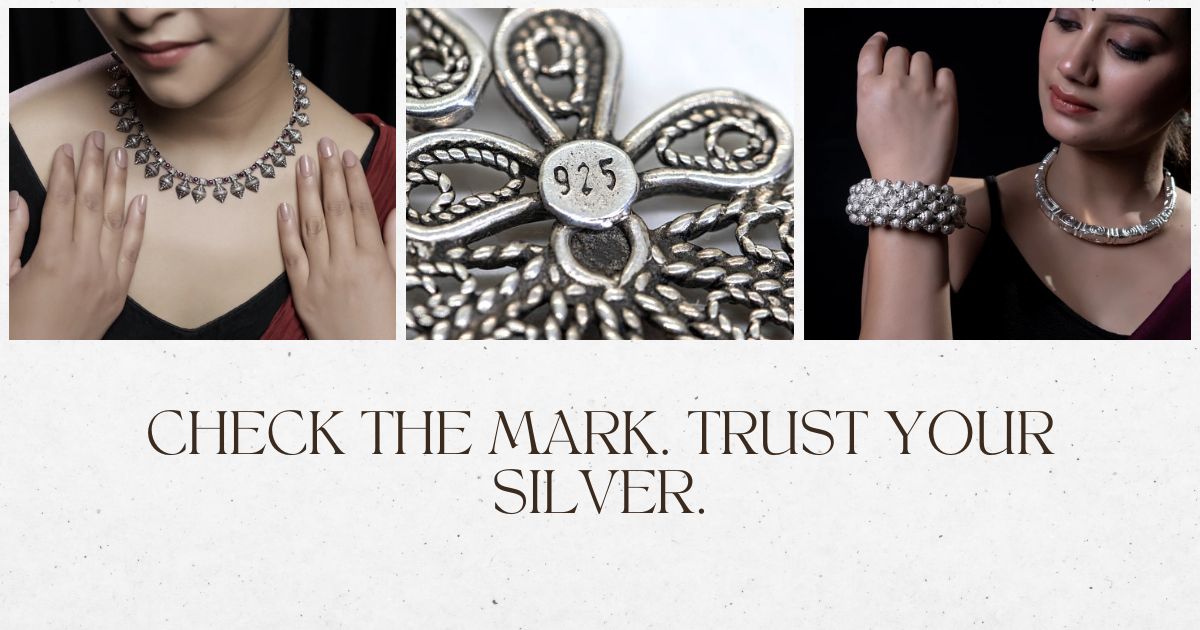
• Purity grade (e.g., 925)
• HUID code (unique 6-digit alphanumeric)

How to Read a Silver Hallmark in India
When you pick up a silver piece and look for the hallmark usually stamped on an inner surface, clasp, or back, here's what you're looking at:
• The BIS logo (a triangle with 'BIS') confirms it's certified
• The number (925, 990, etc.) tells you the exact purity
• The HUID code is your verification key; use it on the BIS Care app to verify the item instantly
How to Verify a HUID Code Step by Step
- Download the BIS Care app from the Play Store or App Store.
- Open "Verify HUID" and enter the six-character code stamped on the piece.
- Check that the article type, purity grade, hallmarking date, testing centre and jeweller registration number all match what you were sold.
- If the code does not verify or the details do not match, do not buy the piece, and report it through the complaints section of the BIS Care app.
Pieces hallmarked before 1 September 2025 carry the older four-part mark (BIS logo, purity grade, testing centre mark and jeweller mark) and have no HUID. They cannot be checked in the app.
Is Silver Hallmarking Now Mandatory in India?
As of September 2026, silver hallmarking is still voluntary in India, while HUID marking is compulsory on every silver article that does get hallmarked.
The HUID-based system has been the official standard since September 2025, and in mid-2026, BIS said it is preparing for a staged mandatory rollout without announcing a date. The government has stated it will evaluate whether to make hallmarking fully mandatory after observing the voluntary rollout period.
What this means for buyers: always ask for hallmarked silver. Any reputable jeweller should be able to provide it. If they can't or won't, that's a reason to pause.
Why This Is Good News for Pahadi Craft
Traditional silver jewellery from Uttarakhand has always been made with real silver, real moulds and real hours of handwork, yet it competed for years against cheaper, adulterated alternatives. Hallmarking levels the field.
At Ejaa, every Kumaoni nath, pahuchi and statement earring is crafted in pure silver, and for makers who have always done the right thing, the hallmark is not a burden but a badge.

Final Thought
At Ejaa, we believe the most beautiful jewellery is also the most honest. Every piece of our pahadi silver jewellery is crafted in pure silver and inspired by Kumaoni heritage, made for people who wear their roots with pride and want certainty about what they are buying.
Frequently Asked Questions
Q1. What does the BIS hallmark mean on silver jewellery in India?
A BIS hallmark on silver jewellery means the piece has been tested and certified by a BIS-recognised Assaying and Hallmarking Centre. It confirms the metal's purity grade for example, 925 means the piece is 92.5% pure silver.
Q2. How do I verify a BIS hallmark on silver jewellery?
Download the BIS Care app (available on Android and iOS). Enter or scan the 6-digit HUID code on your jewellery. The app will show you the purity grade, testing centre details, jeweller registration number, and hallmarking date instantly and for free.
Q3. What is the difference between 925 and 999 silver in India's hallmarking system?
925 silver (Sterling Silver) contains 92.5% pure silver mixed with 7.5% alloy usually copper for durability. It's the most commonly used grade in jewellery. 999 silver is 99.9% pure (Fine Silver), used mainly in bullion, coins, and high-value investment pieces.
Q4. Is it safe to buy silver jewellery without a BIS hallmark?
While hallmarking is currently in a voluntary-to-mandatory transition phase, buying Unhallmarked silver jewellery carries real risk; you have no official assurance of purity. For any serious purchase, hallmarked silver is strongly recommended.
Q5. Does BIS hallmarking apply to traditional or handcrafted silver jewellery?
Yes. BIS hallmarking applies to all silver jewellery and artefacts, including handcrafted, traditional, and artisanal pieces. This is great news for traditional jewellery like Pahadi pieces; it gives genuine craft the certification it deserves.
Q6. Is silver hallmarking mandatory in India?
No, silver hallmarking is voluntary, but any silver piece that is hallmarked must carry a HUID code.
Q7. What does HUID mean on silver jewellery?
HUID stands for Hallmarking Unique Identification, a six-character alphanumeric code laser-marked on each hallmarked silver piece that links it to its BIS record.